May 27, 2012 Contact Calendar The Mix Archives

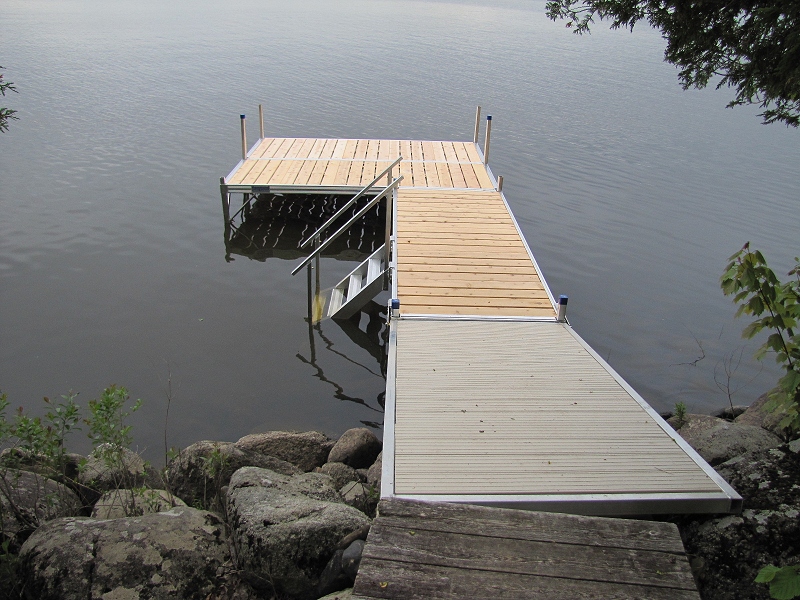
The center of the summer universe...the dock.

Bought on Thursday, delivered on Thursday afternoon, put together and put in over the weekend. Melissa and I put the first two sections in ourselves, then today, Memorial Day, Jim, Martha, Dylan, Chloe, and John helped me put the last section in. With four people in the water it was a snap. This is a great improvement over our old heavy wooden dock. The eight by ten part at the end will have a couple of chairs on it. Stop by for a glass of wine and a sunset.

I read a lot of blogs and sometimes the best part is the conversation among readers in response to the post. An unnamed reader responded to an Andrew Sullivan post with this:

You quote Robert Bellah: "The more complex, the more fragile. Complexity goes against the second law of thermodynamics, that all complex entities tend to fall apart, and it takes more and more energy for complex systems to function."

Utterly untrue. Bellah is making the fundamental mistake of confusing the fate of the individual entity with the fate of the larger dynamic system of which it's part. A quick glance at the overall arc of the 4.5 billion year evolution of life on earth shows the inevitable march of complexity. Complexity does not "go against" the second law, any more than does the metabolism of your individual body—it uses it, through a related, albeit higher-order mechanism, to advance higher and higher stages of self-organization.

More complex systems are in fact far more efficient in their use of energy than less complex ones, which—from the thermodynamic perspective—is precisely what drives evolution (biological, social, technological and mental). Dawkins might not like it, but from the system's science perspective, evolution is not directionless: Increasing complexity is built into the fabric of the universe.

Bellah not only has it deeply wrong on the science, he has it deeply wrong on the implications for philosophy; at least to judge by this short snippet you quote: more complex is not more fragile, it is more robust.

His outlook reads as dour and pessimistic. That's not the world as it is—that's Bellah's projection onto it, based on a deep misreading of the interplay of thermodynamics and biology. The truth may be something almost 180 degrees different—something much more akin to Malick's vision in "The Tree of Life:" not only is the evolution of biological complexity inevitable, given sufficiently propitious initial conditions, so is the evolution of mental, emotional and spiritual complexity—including consciousness, empathy, compassion, and grace. To cite Einstein, "The most important decision we make is whether we believe we live in a friendly or hostile universe."

Bellah's science—again, to judge by a very small snippet—is inherently hostile, at least from our human perspective. Were his science right, we would all perforce become mid-50's French existentialists. But it's not. The applicable science is in fact friendly—I would say, grandly, magnificently friendly, even if, from the individual human perspective, humbling, awe-inspiring, or, like Krishna in his cosmic form, or Yahweh in the whirlwind, sometimes terrible to behold.

One of the most courteous, tortured and exacting exchanges among readers was on this Vox Nova article. Catholics in the impossible position of trying to make their medieval religious inanity jibe with anything like how people are living and changing in the real world. But good marks for sentence structure, boys.

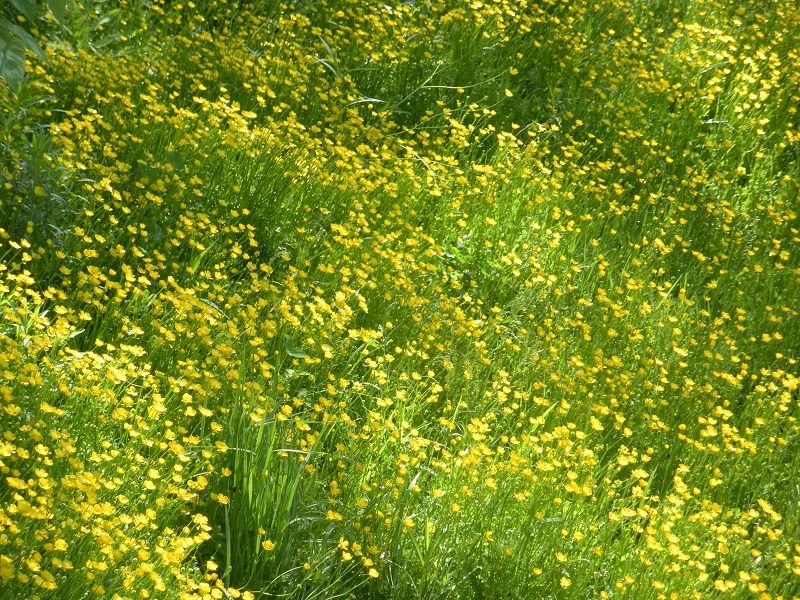
On a bike ride around the lake yesterday, I saw this patch of flowers across from Triplet Park. I need to go to work tomorrow to sit and a desk and rest up from this very physical long weekend.

Last Time